| Slant Six Forum https://www.slantsix.org/forum/ |
|
| Centrifugal Advance Curve........ https://www.slantsix.org/forum/viewtopic.php?t=13264 |
Page 3 of 3 |
| Author: | emsvitil [ Thu Jun 23, 2005 11:33 pm ] |
| Post subject: | Test Series 8.... |
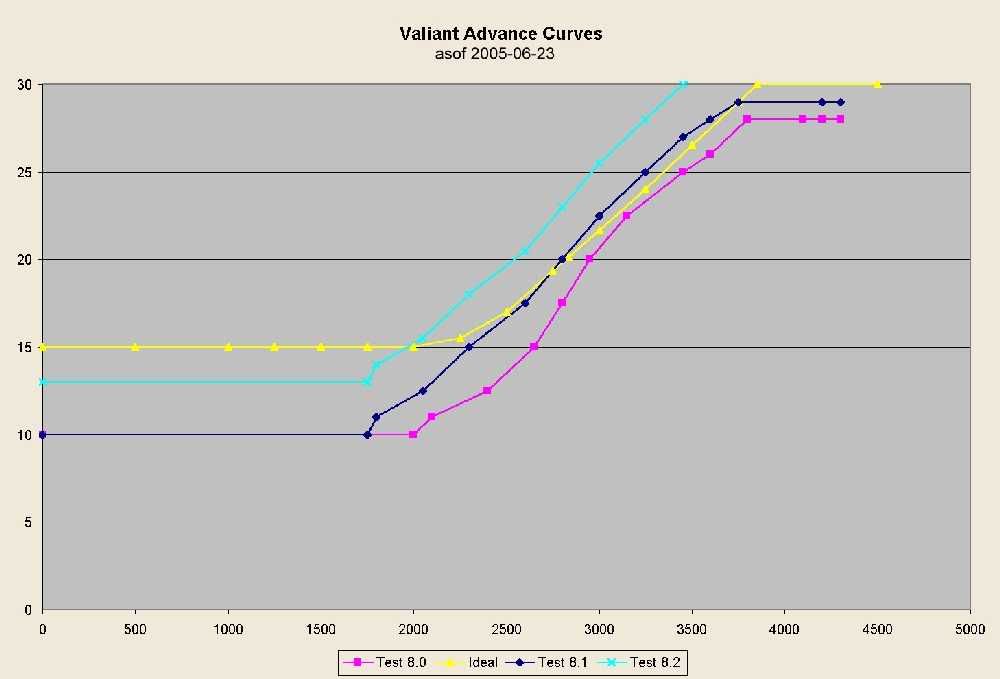
Ok I tried splitting the load up between the 2 springs.......... Test 8.0 29(stock) & 36lb spring 10 initial no testing, felt that it had too much preload and wasn't very straight. Test 8.1 29 & 36 less preload 10 initial might have had some pinging Test 8.2 as 8.1 13 initial definite ping ![]() As a hunch, I suspecting that's it preload that causes the initial delay and bulge in the curves so on to test 9 |
|
| Author: | emsvitil [ Thu Jun 23, 2005 11:35 pm ] |
| Post subject: | Test 9.... |
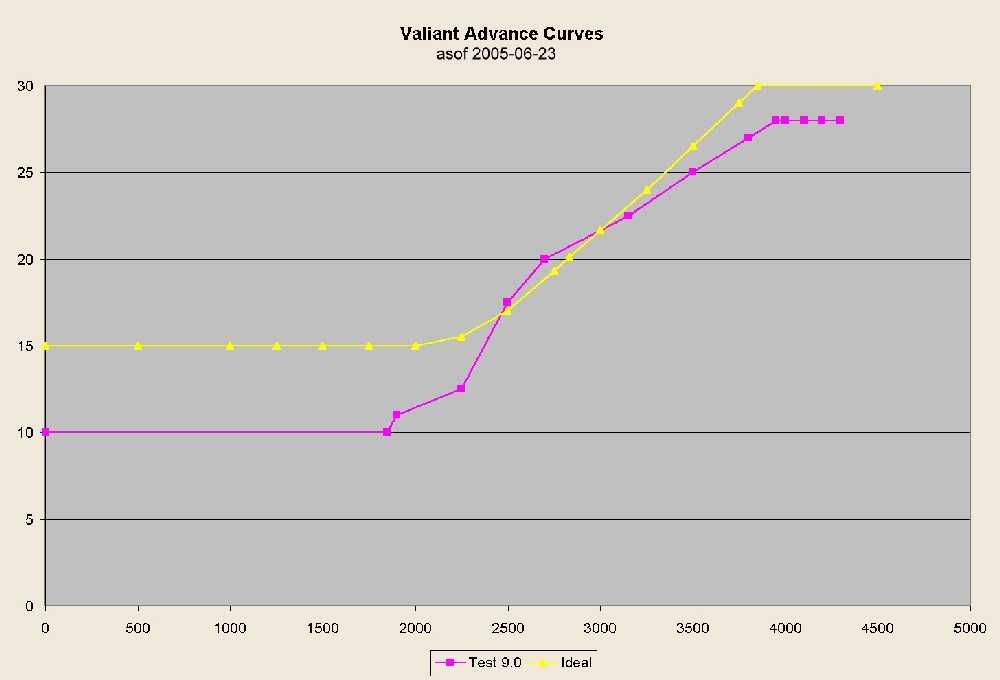
Test 9.0 29 & 48 slightly less preload than Test 8.... 10 initial no test... after the initial bulge I felt that the slope was too flat... ![]() So to test 10.... |
|
| Author: | emsvitil [ Thu Jun 23, 2005 11:55 pm ] |
| Post subject: | Test Series 10.... |
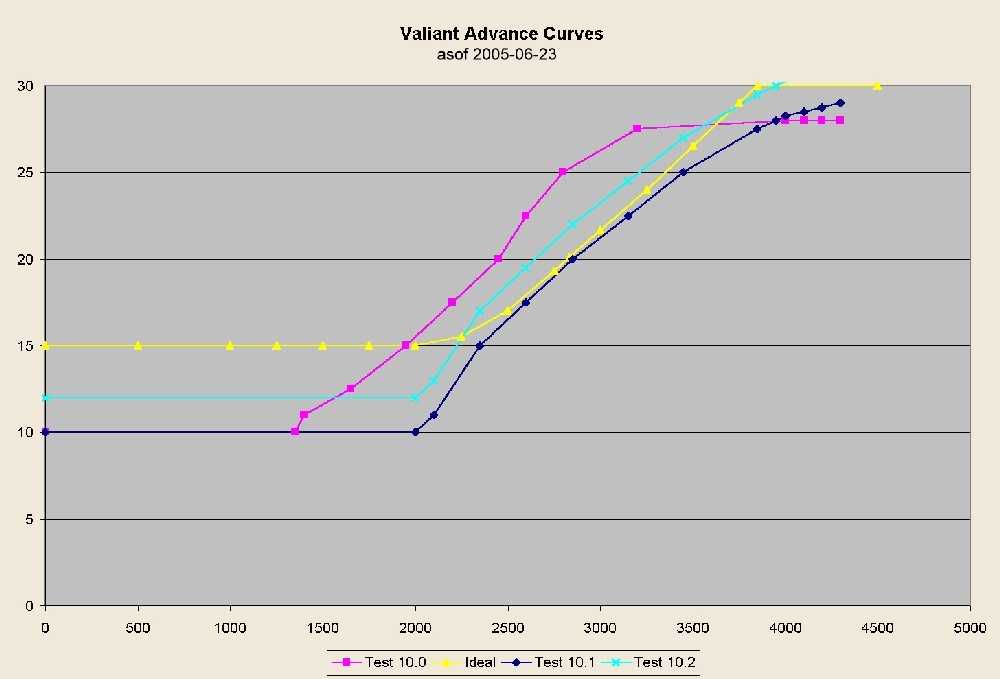
Test 10.0 29 (less preload) & 41 (no preload, hopefully steeper slope) 10 initial no test.... took out too much preload so more preload Test 10.1 29 (a bit more preload) & 41 (and some preload here) 10 initial looks much better......... no pinging Test 10.2 29 & 41 12 initial hints of pinging ~3400..... ![]() Don't think I can get rid of the flattening after 3500 rpm, and the low end curve is as about as smooth as I can get it. So I'm going with this one........... What's interesting, is that this curve is almost exactly the same shape as the curve in test series 6, which was done with completely different springs and with a lose secondary spring.............. (I think the car likes this curve, it's shown up twice.... As for the 2 spring (one lose) setup, I think it's for jumping the advance curve up, then letting the secondary spring control the curve. Most likely part of this is due to the low 2.5degree BTDC stock timing setting. I also think there's only enough tension in the primary spring to stay closed at idle..... And I think that when adjusting your distributor to start at 10 & up degrees BTDC, the need for the 2-step curve is diminished. A programable box would be much easier............. Are there any black boxes you can insert between the pickup (need to convert to electronic and then lock up the centrifugal advance) and the ignition control module that are cheap and have full curve ability????????? (not just start, slope, end, but lets say every 100 rpm.....) Now I get to adjust the vacuum can........... |
|
| Author: | argentina-slantsixer [ Fri Jun 24, 2005 5:14 am ] |
| Post subject: | |
MSD offers a timing computer that lets you program the curve you want. You get to lock the dist and set it to max advance, the box then retards your initial timing for starting and then increases vacuum up to your specs in programmable steps. they also have a neat timing advancer/retarded wich is controlled by a fancy dash knob. |
|
| Author: | mpgFanatic [ Fri Jul 01, 2005 8:21 am ] |
| Post subject: | How are you measuring "ideal"? |
Quote: Now look at the picture below:
Fascinating! Just stumbled across this thread. I didn't think anyone but me would do this much research and testing... The pink and yellow are the actual curves, the other 2 curves are what I think the curves should be. MAJOR question: how are you defining where you "think the curve should be"? There's been a lot of talk about why an ideal WOT curve varies from one engine to another and from one car to another, all very valid points, but I've seen no mention from anyone about testing a particular combination to determine its own theoretical ideal. Some people have mentioned listening for pinging-- but by the time that's audible (even to instruments), you're already slightly past the point of maximum power (and you're subjecting the engine to much more stress than it needs because the cylinder pressure peak is occuring too early.) There is a much better way, that Dr. Chris Jacobs describes quite well in his book, "The Doctor's Guide to Optimizing Ignitions," but I haven't seen any discussion, so I'm curious... Quote: Last...vacuum advance...its purpose is only to increase timing at part throttle higher rpm cruise for fuel economy. [...]
Wow, yes. After many, many hours of testing with a variable advance circuit and a fuel flow sensor, I came to the exact same conclusions: My slant 6 wants about 44-45 degrees, given a diet of 93 octane (M+R/2) and steady 70 mph highway speeds with 12-13" vacuum. Sheesh, I could have saved myself the trouble and merely asked you. Typically, you want about 45 degrees going down the freeway for max economy... I suppose I ought to contribute to the research by digging up all my graphs and scanning them in. - Erik |
|
| Author: | emsvitil [ Fri Jul 01, 2005 12:40 pm ] |
| Post subject: | Re: How are you measuring "ideal"? |
Quote: MAJOR question: how are you defining where you "think the curve should be"? There's been a lot of talk about why an ideal WOT curve varies from one engine to another and from one car to another, all very valid points, but I've seen no mention from anyone about testing a particular combination to determine its own theoretical ideal. Some people have mentioned listening for pinging-- but by the time that's audible (even to instruments), you're already slightly past the point of maximum power (and you're subjecting the engine to much more stress than it needs because the cylinder pressure peak is occuring too early.) There is a much better way, that Dr. Chris Jacobs describes quite well in his book, "The Doctor's Guide to Optimizing Ignitions," but I haven't seen any discussion, so I'm curious...
The initial 'ideal' curve was quesstimated from static advance settings......- Erik i.e., no springs, so curve was flat, and same throughout rpm range. I had the timing at 2.5 deg, 5,7.5.....,30 degrees and figured out when it pinged... Got up to 17.5 deg before I found any pinging. If the ping then dissappeared at a higher rpm, I figured that advance was safe for the rpm........ Sort of a 'go' 'no go' method. I then plotted out the curve, and straightened it a bit as an initial curve to strive for. Then I'd put in some springs and see how close I could get to my 'ideal' curve. As a double-check I would see if the newly made curve pinged where I expected it to (usually at least 2 tests with different inital settings). Occasionally I found that it would ping when I didn't expect it to, or wouldn't ping when I expected it to. I would then adjust the 'ideal' curve to account for this....... You can see that my initial ideal curve is a 2-step curve, but it evolved into a linear 1-step curve with further testing. Since I was testing in 2.5 & 2 degree increments, I sort of figured that it was close enough to pick the last save spot as the ideal location (I read somewhere that the best spot is 2-3 degrees before the ping location). Without a brake dyno and the ability to adjust timing on the fly, that's probably the best I can do....... I did read the Dr's book, and that's where I got the basis of my testing, I just figured using the static timing intially was a easier since I knew exactly what the timing is, and only have to observe RPM. |
|
| Author: | gmader [ Fri Aug 21, 2009 9:13 pm ] |
| Post subject: | Great thread and research |
So, I have been working on my secret project, getting the barracuda on megaquirt. I am using EDIS for the ignition, controlled by the megasquirt, (using the megasquirt 'n spark extra firmware. This thread has been a great starting point for my ignition curve. Thanks for doing the research. Greg |
|
| Page 3 of 3 | All times are UTC-08:00 |
| Powered by phpBB® Forum Software © phpBB Limited https://www.phpbb.com/ |
|