Slant Six Forum
https://www.slantsix.org/forum/

Engine Rebuild - Order of Steps
https://www.slantsix.org/forum/viewtopic.php?t=51112
Page 3 of 3

Author:  ceej [ Sat Mar 09, 2013 4:53 pm ]
Post subject: 

You have the right one. At the bottom of the caliper is a depth gauge. As you open the jaws, it protrudes from the main scale. At Zero it should be flush with the end of the scale. As you open it, it comes out of the scale, and should be accurate, so long as you keep the base of the scale correctly alligned with the deck.

Near the bottom of this instruction link there is an example of using the depth guage that is part of the caliper.

A proper depth gauge can be used for more accurate readings, but what you have there will be accurate when used carefully. :D

CJ

Edit: Oops! Rick beat me to it! :lol:

Author:  Eatkinson [ Sat Mar 09, 2013 6:23 pm ]
Post subject: 

Thanks guys. That was a little ironic. The caliper I posted is not the one I bought: I don't believe the one I bought had that depth extension piece in the tail. So I went back and bought that one. Jeez. 3x at Harbor Freight today. So glad it's only 6 min away!

I purchased this set of telescoping gauges to measure the bores: will these work?

http://www.harborfreight.com/6-piece-te ... -5649.html

Author:  Fopar [ Sat Mar 09, 2013 9:24 pm ]
Post subject: 

Yes but they will be somewhat stickey, but you should be able to measure the bores. Try using them several times in the bores (practice makes close to perfict).

Richard

Author:  Eatkinson [ Sun Mar 10, 2013 12:45 pm ]
Post subject:  So what do these numbers mean?

Ok, so I have measurements. And I wonder what they mean, with regards to figuring out how the block was originally decked relative to the crankshaft cenerline. Wonder also what they tell me regarding compression and how I might have the block machined:

Piston #1: .1835" to deck both front and rear piston edges.

Piston #6: front edge: .1875", rear edge: .1915".

Going to remove the crank and pistons today.

Author:  DusterIdiot [ Sun Mar 10, 2013 1:44 pm ]
Post subject:  Deck Height...

When using a compression calculator online (or using the formula by hand), this number is called the deck height...given the "average" of the numbers you have and how much 'gunk" was on top of the piston when measuring the average is about .185 down in the bore at TDC which is about right for a 70's slant six.

So if you wanted to calculate your engines actual static compression ratio you would use:

Bore:3.40
Stroke:4.125
Deck Height: .185 (if the formula is for domed pistons this my need to be entered in as -.185)
Shim head gasket would be about .02" thick by what the bore is on those.
You will also have to CC your head, but generally a 1974 Drool Tube head is about 54cc on average...

Given this, using the same calculator you can check to see what your target compression would be by overboring and taking a cut off the deck (a .100 cut on the block deck .185 would mean your new pistons would be .085 down after assembly), iff taking some off the block and some off the head you will then apply Doc's formula of .0066 per 1 cc (so a cut of .0066 of your 54 cc head would make it a 53 cc head).

Given the amount above (with the 54 cc chamber volume assumption), the DCR calculator I use shows that your slant six was at about 8.24:1 compression...

If we played around at wanting to get a 9.x:1 compression with a .020 over bore, and using a standard Felpro headgasket (.039" thickness on average)...you would need to: cut the head to get a 52 CC chamber, and deck the block after boring .020 over about .080 for a .105 deck height...
this would net you about a 9.39:1 SCR...if you know what you are looking for using these numbers and measurements it will allow you to tell the machinist what he needs to do and gives you somethign to check when you reassemble since the machinist can make a mistake trying to calculate it and if over the amount needed you may be needing to rethink the build (more cam for the compression...or the machinist redoes the work if he biffed getting your specified measurements correct).


-D.Idiot

Author:  slantsik [ Mon Mar 11, 2013 1:35 am ]
Post subject: 

Those t gauges can be tricky.
I was not sure how to use them correctly so i searched on line for instructions.
Place t into bore roughly where you think center is.
tilt the t so the handle is about 15-20 * off parallel to bore walls.
Gently snug lock a little.

Now move the t side to side a little while pulling the handle to be parallel with bore walls. This part takes some practice and feel to get right.

you should feel 1 spot where the handle will want to straighten the easiest/most.
when you find this spot pull the handle parallel with bore walls.
Then tighten the lock and gently remove by tilting handle and lifting gauge out.
measure with your shiny new calipers,being careful not to squeeze the t together.

How did you find TDC, this must be accurate. Do you have a degree wheel? if not print one off the net and use that.
or did you use the stop method and find center of "stops" on balancer?
or some other way?

#6 seems strange, front to back of piston should be the same, but I think that was the damaged piston?
The deck could be out by the difference in deck heights from front to back, or the rods could be different lengths ,twisted,or piston damage, or different rod piston length combo etc.
Once the guts are out you can see for yourself.
just make sure TDC is correct and measure again before pulling the guts out.

Brendan.

Author:  Eatkinson [ Mon Mar 11, 2013 1:51 am ]
Post subject: 

Well, pulled the pistons out today, but didn't get to the crank, because I need to borrow/go pick up a 3/8" 12 sided socket. Don't have that one in the inventory of tools. Can't take off the rear main seal without it.

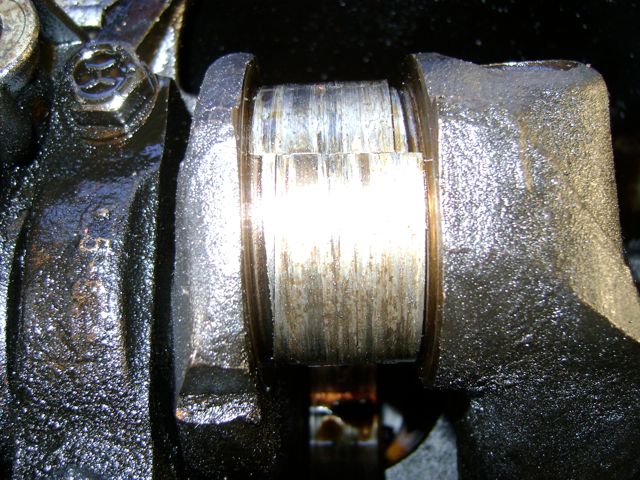
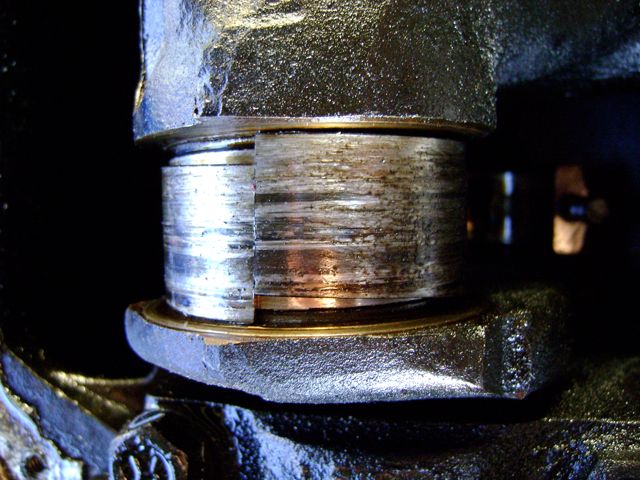
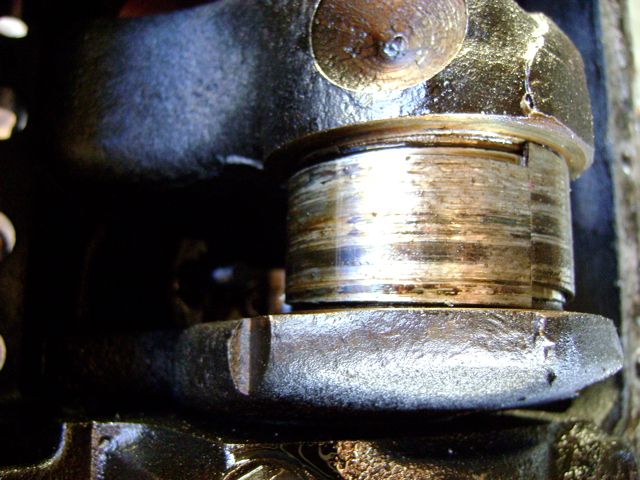
BUT, take a look at #6 piston and crank shaft journal. A spun bearing! So far, this is the most obvious thing that was giving me bottom end noise: everything else looks copacetic. There was a heavy burned-oil smell as I dismantled #6. But, there's no telling when the other rod bearings would give out.. They seem on the verge of replacement, though one look at the bearing surface shows deep wear in pretty much all the rod shafts.

#6:

Image

Image

Image

Author:  Eatkinson [ Sat Apr 06, 2013 3:00 am ]
Post subject:  Update

Update: Block has been torn down. Everything's apart. But as things happen, project has been dragging a little. Time to jump start again.

To re-cap, this build is a mileage/performance street build. Nothing too major, just some common-sense upgrades.

Doc is building me a head off a '69 225 with the new combustion chambers. All good there: won't be re-using my original head.

Now, I have to take the block to go get machined. But I'm dragging a little for a few reasons:

1) The machinist literally down the street from me is the most convenient and has been in biz 35+ years. Maybe that should tell me something. BUT, I don't know how good he is, nor how professional. I have mixed feelings...

2) Doc recommended a .060 deck off the block to get an 8:1 DCR, using the stock cam. Sorry DusterIdiot - thanks for the post, but remember, this is a '63 225 I'm rebuilding, not the 74 225. Not sure if those numbers you gave me were right for my '63. However, though I planned on re-using the stock cam, I'm getting funny feedback from my machinist. When I told him I planned on having the cam re-ground, he looked at me as if I were from Mars. Not quite sure what's flying around in his head.... Is grinding the cam and installing new bearings standard? At 172K miles, I'd think it's time to reman and upgrade. The way Doc explained it, grinding the cam is a crapshoot: you don't know what you're going to get until you have it. So I'm just wondering: is the decking numbers to give the mechanic correct, regardless of what I end up with, once I grind the cam?

2A) How much do I tell my guy to bore the cylinders? I have no idea what degree of overbore I need. Or does he just measure and tell me the next step up?

3) I'm dragging also because I don't know what to take to the machinist or what he'll need. I have the block, and the crank, but I haven't bought new pistons, rods, bearings, rings, etc yet. Am I now at the point where I need to buy these things and just give them to my guy? Since he's just doing the machine work, which of these parts does he need to get the machining done correctly?

4) What am I getting back from him? Just the bare block with or without the re-ground crankshaft installed?

Trying also to figure out how to transport the block, now that the lifting boss on the head is still attached to the head, which is off. What do other people do to disengage the block from the stand for machining? when there's no head to lift from?

Author:  slantsik [ Sun Apr 07, 2013 6:15 am ]
Post subject: 

Hey,
Quote:
So I'm just wondering: is the decking numbers to give the mechanic correct, regardless of what I end up with, once I grind the cam?
The Dynamic Compression Ratio (DCR) Is determined by your intake valve closing point,and piston speed,which is partly determined by rod length.
The earlier the intake valve closes the more DCR you have.
The later the intake valve closes the less DCR.
A DCR of about 8:1 should be safe to use with most fuels.
You first need Static Compression Ratio (SCR) so you can determine your DCR.
You will need an Idea of when your camshaft will close the intake valve.
To find this you will need a few camshaft specifications.
Intake duration at 0.050" in crankshaft degrees
Intake lobe centerline in crankshaft degrees
If for example your intake duration was @ 0.050" 200* at a centerline of 110*
you halve 200* =100* then add that to 110* = 210* ATDC which is 30*ABDC . Then you add 15* which is 45*ABDC. This is your valve closing point.
Clear as mud.


As you can see ,knowing your camshaft specs in advance will help determine what you need to do to determine SCR and then DCR.
A stock cam intake valve would probably close around 35-50* ABDC
at a guesstimate.
Here is a couple calculators to work with
http://kb-silvolite.com/calc.php?action=comp2

http://www.kb-silvolite.com/calc.php?action=comp
Hope this helps to get moving again with the rebuild.
Brendan

PS you have probably seen this thread but some good info here
http://slantsix.org/forum/viewtopic.php?t=27439

Author:  Supercharged SL6 [ Sun Apr 07, 2013 5:26 pm ]
Post subject: 

First thing take the crank to a machine shop that can grind a crank, they will measure it and tell you how far undersize it will need to be ground, I use NAPAs shop, there reliable and they provide the bearings at jobber price. Also the machine shop that bored my block & did my head didn't have a crank grinder. If your just going to use stock type pistons .030 over should clean up even the worst worn cylinders. Talk to your machine shop to see what he can or can't do, if he can grind the crank ask how much to grind crank & bore block, then call NAPAs shop and see what they get and get a price of bearings, pistons, rings while your at NAPA. It's up to you to decide if your going to assemble the short block or pay the machine shop to do it. As far as getting block off engine stand, two people can lift bare block with no problem, I lifted mine off buy myself and put it in back of pickup. Remember a machine shop will do anything for a price, like supply parts, he should be able to do the whole job but whats it going to cost, it could be more $ if he supplies the parts, get a quote

Author:  1930 [ Wed Jun 04, 2014 5:49 pm ]
Post subject: 

btt

Page 3 of 3 All times are UTC-08:00
Powered by phpBB® Forum Software © phpBB Limited
https://www.phpbb.com/